Rethinking Religion
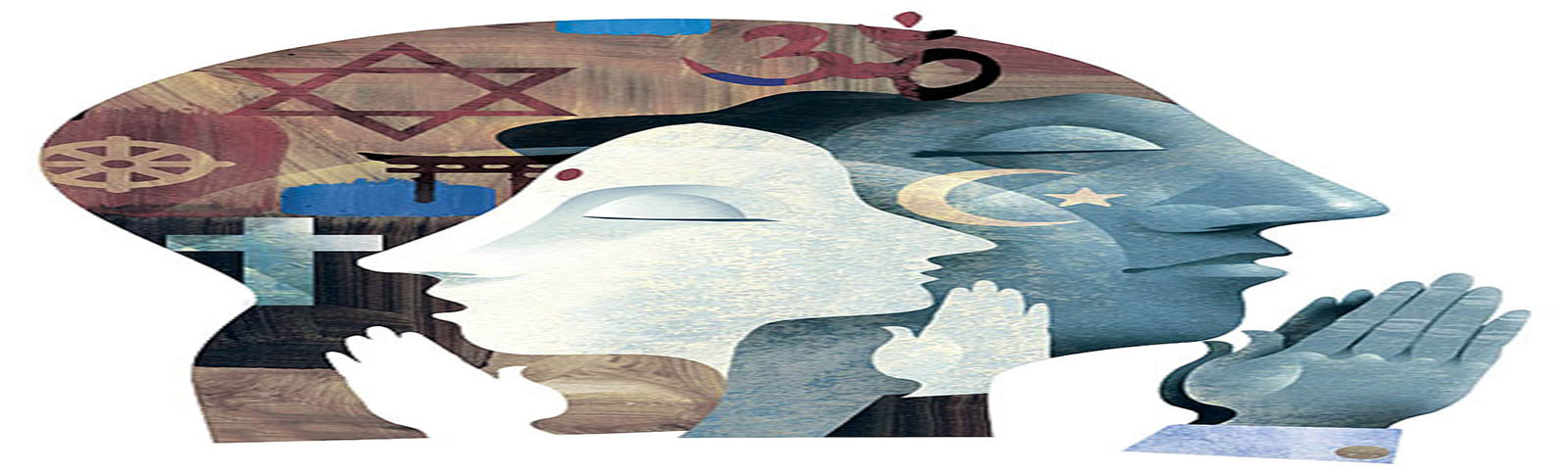
Why should we rethink religion? Because whether we like it or not, it can be of great help in getting us out of the quagmire we have all got stuck in. Despite the harm that has been perpetrated in the name of religion, we still have a lot to learn from it. However, we should reflect deeply with a fresh outlook on its role in human life and achieve an in-depth understanding of its real nature. Till now we have gathered understanding through a mind tarnished with so many imperfections. Thus we have distorted and misinterpreted the pure science of religion, and reduced it to a matter of belief, culture and fanaticism.
We cannot rethink religion with our subjective and conditioned mind. The theme is interesting and challenging, but there are huge implications. Subjectivity and a sense of belonging and identification to a particular religion are major barriers in the process of rethinking religion. To make myself more explicit, I would say that when people identify themselves with their religion and community, it is very difficult for them to be objective and rational. To think objectively, one needs to have a free mind, that is, one bereft of any attachment whatsoever to any school of thought.
Since childhood, children are crammed with religious beliefs. They are hardly given the opportunity to think about the meaning of religion and its relevance to our modern world, and question certain principles and practices. In fact, some religious principles are not compatible with the modern world. Whether people understand it or not, they merely have to follow blindly. Some religions even prohibit querying about their practices and precepts.
Religion should be an experience, a personal one. We cannot borrow from the experience of others, learn by heart and follow blindly as is the case today. Religion is the science of uniting man to God. Like in the case of science, we should be able to question religions, for those who bequeathed them lived in eras that were very different from ours. In science, the scientists who challenge past theories develop better ones, invent new approaches and many a time prove their predecessors wrong. This is how we should approach religion, for not everything in it is eternal. We should learn to move with time.
There are things that do not fit in a particular period of time. For instance, Mahavir, the founder of Jainism, lived as a naked master and his nakedness was natural to him. This, however, does not imply that all followers of Jainism or any master who is born among Jains should go about naked. That would be absurd and mere copying from Mahavir.
A religion is a map. An individual can invent his own map or use that of his predecessors, who were also seekers before they attained awakening. After enlightenment, some invented new paths, which later became the religions we know today. It is not necessary that we take everything from a religion or follow the religion itself even though we are born in a particular community. If we are forced to do so or are brainwashed, this will mean that we are not religious because to become religious, one should be free.
The spirit of religion is a spontaneous affair born out of seeking, understanding, learning or as an inner feeling. Why should it be imposed? I cannot force my child to follow the map I have invented. Doing so would deprive him of his basic human right to think, search and experience for himself. All the people of a community cannot have the same temperament that makes them follow the same religion. If such is the case, and it is indeed, it is nothing but an imposition, a brainwashing and a mechanical religiosity, which is no religiosity at all.
Today religion has become a story told by one person which is followed and repeated by future generations with blind faith, without any questioning about its veracity. Is this a rational and scientific approach? We leave the essential and become fanatics of the inessential. For example, we debate about the Da Vinci code. Why do we wish to know whether Jesus was married or not, whether he had children or not? In what way will this help us work on our anger, jealousy, hatred, violence and so on? Where will that lead us?
True religion teaches man how to realise that he is essentially divine. After this realisation, he becomes a completely transformed, awakened and fulfilled human being. But instead of working in that direction, he wastes his time in fanaticism, beliefs, sensuality and materialism, and yet wishes to have peace of mind, good health and harmony in the world. Jesus said that the Kingdom of Heaven is like a hidden treasure, one has to dig to have it. Krishna said that one's very soul is divinity. Mohammed said that God is nearer to us than our jugular veins. Instead of focussing on how to attain that state, we have created such a big fuss around religion. Why? Purely out of ignorance!
Can't you see, oh man, that by focussing on the inessential, nothing positive has come to you? You have wasted your time in beliefs, rites, rituals and superstitions and have stripped yourself of the energy that could fuel your mind towards spiritual evolution. Religions should teach man how to experience divinity right here and now. They should show the way to the transformation of the mind and the heart. Religions promising a world beyond without showing how to acquire the experience right here and now do not contribute to the advancement of peace, love, brotherhood and harmony, nor do they make a better world. They turn people into mere believers or robots, not into better individuals.
If religion has something to offer, it should first liberate you from its clutches and allow you to become a human being so that you can choose the path you wish to take. It should not seek to make you a better Christian, a better Muslim or a better Hindu for that matter, but a better human being. Religion should help you to see truth as it is, not as it is in books, whether religious or scientific. It should focus on self-education for that is the most essential thing. How can we believe or accept God when we are ignorant of ourselves? I do not believe one can become a good individual without knowing oneself fully. Man is a replica of the cosmos in miniature. Only by knowing himself can he know God and the creation. Knowing oneself clearly and fully, one cannot make any mistake about one's aim and relationship with nature and God.
Today man is like a rudderless boat because he is ignorant of his real nature. If religion becomes a problem or if inter-religious or inter-faith understanding and dialogue do not work, this proves that we are not yet intellectually, scientifically and spiritually mature for that. The least we can do is to leave all religions aside, though I am very sceptical whether many will dare do so, and focus on the root cause of human degradation and find solutions to them.
One thing is clear in this context - man is himself the origin and cause of all problems, not the poor devil. The mind, the senses and the heart are both the cause and the solution, then why not tackle them? Doesn't everything originate from the mind and the heart? Apart from a radical transformation of these, nothing can bring about a positive change in our behaviour. What avails us if, despite belonging to a religion (and there are so many religions these days!), we remain ignorant of ourselves and have an unconscious mind and an impure heart?
Let us leave religions aside and work upon ourselves to discover peace, love, freedom, tolerance, forgiveness and understanding. Isn't that possible? Why not? After all, though religion has always taught about all these, yet we are still very far from achieving them, thus profoundly irreligious. Why? It is because we have avoided the discipline and style of living that could help us in the attainment of virtues. Instead, we have adhered to the superficial aspects of religion and have reduced religion to mere belief. We have avoided the ego-shattering practices and teachings; we have refused to face ourselves and our inner evil. This is why we have remained spiritually poor, despite the fact that we are knowledgeable and scientifically advanced.
Peace, love, freedom, intelligence, tolerance, brotherhood, living in harmony with both nature and one another, and other virtues do not come from belief in God, after-life, prophets and scriptures, but rather from the depth of one's being. The whole question is how to tap these from there. This is the most religious question that exists. No, do not talk of morality, control, bookish knowledge and inculcation: all these have always failed. You should rather bring in attentiveness, inner calm, observation, watchfulness, willpower, learning and openness of mind. This is what I call self-education or true religion - it is the crucial need of the moment. A truly religious person is a self-educated person and that is absolutely rare these days.
Let us leave religions aside and work upon ourselves to discover peace, love, freedom, tolerance, forgiveness and understanding.
Religion should help you to see truth as it is, not as it is in books, whether religious or scientific. It should focus on self-education for that is the most essential thing.